The gateway to hell: Houska's legend and its history
Every castle in Bohemia has a ghost. Houska has a hole into hell, a chapel built as its lid, and seven centuries of people who swear the lid does not quite fit. These are the stories as they are told, and next to them, what the records say.
A castle with no reason to be there
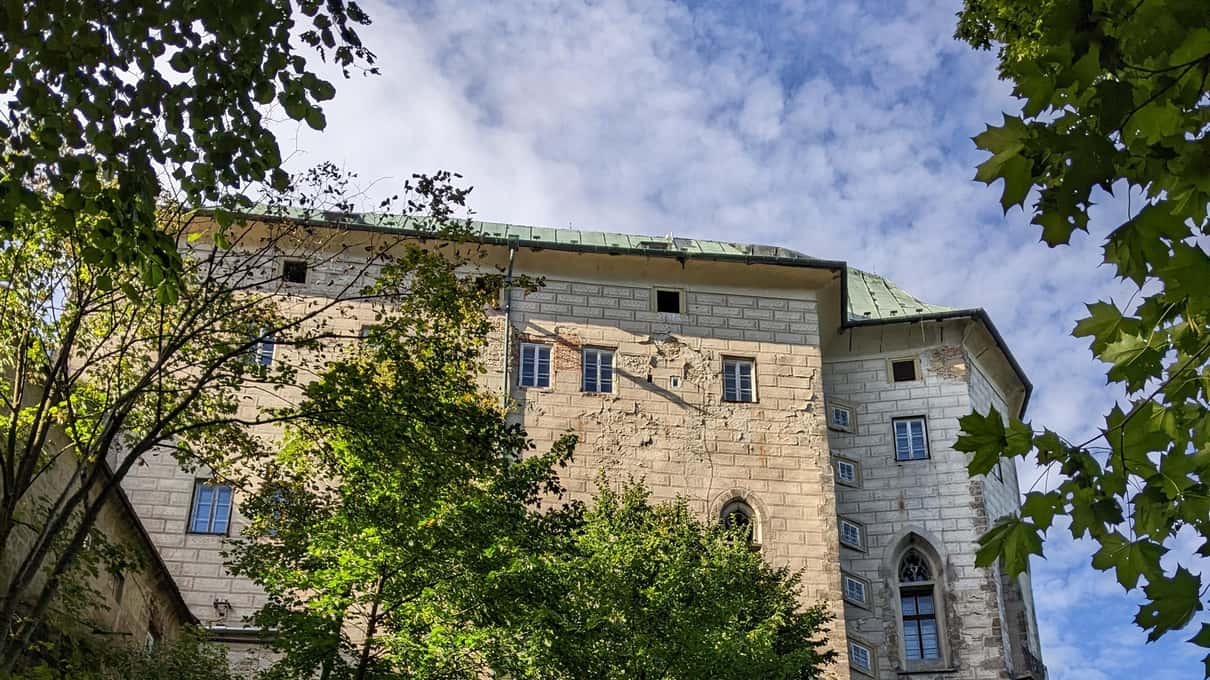
Most medieval castles answer an obvious question. They guard a river crossing, a trade road, a mine or a border. Houska answers none of them. It stands on a sandstone rock in the pine woods north of Prague, about 47 km (29 miles) from the capital, far from any route that mattered in the 13th century. In the legend's telling it had no well and no kitchen when it was new, and its strongest defenses faced the courtyard, not the forest.
For people who love the legend, that is the whole case. A castle that guards nothing outside must be guarding something inside. Historians are calmer about it. They see a royal castle from the reign of Přemysl Otakar II, built to administer the king's lands in a thinly settled region, and rebuilt so often since that its first layout is hard to read. Both camps agree on one thing. When you walk up through the trees and the white walls appear, the place feels watched.
What climbed out of the dark
The story begins before the castle. Under the rock, the villagers said, ran a crack so deep that a stone dropped into it never made a sound. At night things came out of it. The descriptions vary with the teller, but they share a family resemblance. Creatures part animal and part human, some with the wings of bats or birds, that crept down to the farms, took the animals and sometimes the people who went out to look.
Nobody could fill the hole. Stones, earth and timber disappeared into it. So the order came, from the king himself in most versions, to seal it the only way left. A stone floor over the mouth of the pit, a castle around the floor, and on the very spot, a chapel. The pit was not destroyed. It was locked.
The prisoner on the rope
The most famous part of the legend comes just before the sealing. The builders, or the lord, wanted to know what was down there. A prisoner condemned to death was offered his freedom if he would go down on a rope and come back to tell them. He agreed, they lowered him into the blackness, and within moments he began to scream.
When they hauled him up, the story says, his hair had turned white and his face had aged by thirty years. He could not or would not describe what he had seen. In some versions he went mad, in others he died a few days later. In all of them, nobody volunteered to go next, and the masons started work. Guides at the castle tell this in the chapel, and it is a different story when you hear it standing over the spot.
A chapel for a lid
The chapel is real, and it is the oldest treasure in the castle. Its walls carry murals painted around 1330 and in the early 15th century. Among the figures is Saint Michael, sword raised over the dragon, the warrior angel who, in the Book of Revelation, hurls the great dragon down from the sky. Believers find that choice telling. If you wanted to stand a guard over a door to hell, you would paint Michael.
A historian would point out that Saint Michael appears in chapels all over Europe, and that Saint Christopher, the patron of travelers, is painted at Houska too. The chapel was restored in 1928, and what you see on the guided tour is a beautifully kept Gothic room, not a trapdoor. The castle's own website introduces the pit with the words "according to legend", which is the right tone to carry with you.
Hear the story where it happened
The private day trip from Prague drives you to the castle on the rock, includes your ticket for the guided tour into the chapel and adds Kokořín Castle and a Czech lunch. ~$923 per group of up to three, open dates April to October only.
The ghosts that came later
A building with a legend like that attracts others. The castle's website mentions a faceless figure in a black monk's hood, seen in the windows and along the walls, and repeats the rumor that skeletons of something not quite human lie under the floors. From the Thirty Years' War comes Oront, a Swedish commander said to have dabbled in black magic at Houska, and whose spirit, depending on who tells it, still keeps the place. Others mention a headless black dog, a woman in white, scratching from below the chapel floor.
- The hooded figure, faceless, told on the castle's own website as legend
- The skeletons, a rumor the castle repeats with a careful "it is said"
- Oront, the sorcerer commander of the Thirty Years' War, in Czech folklore
- Sounds from below, the oldest and least specific tale, and the one that keeps the others alive
The war years, and the myth they grew
The 20th century gave Houska its newest legend. During the Second World War the area lay in the Sudetenland, and the German army used the castle until 1945. Czech sources add that a regional SS staff was based there and that the Reich security office moved archives and books to Houska in 1943. Those are records of an occupying army looking for quiet, safe buildings in the countryside.
From that grew the story told in countless videos, that Nazi occultists ran experiments over the pit, and that bodies were found when the soldiers left. No document supports it, and the castle's own history does not mention it. Like the creatures and the prisoner, it is best enjoyed as a story, ideally in the chapel, with the door closed.
What the records say
The documented history is shorter than the legend, and gentler.
| When | What happened |
|---|---|
| 13th century | Castle founded, traditionally under King Přemysl Otakar II; some historians credit the lords of Dubá in the 1280s |
| 1316 | First written mention of Houska |
| c. 1330 | Oldest murals painted in the chapel, more added in the early 15th century |
| 1584–1590 | Rebuilt as a Renaissance residence |
| 1924 | Bought by the industrialist Josef Šimonek, restored by 1930 (chapel in 1928) |
| 1938–1945 | Used by the German army in the occupied Sudetenland |
| After 1989 | Returned to the Šimonek heirs |
| 1999 | Opened to the public for the first time |
Houska's sister castle in time is Bezděz, founded by the same king in 1264 and visible on its hill to the north. Bezděz and Mělník covers it, and Kokořín, the castle in the next valley, has legends of its own.
Visiting with the legend in mind
Go for the atmosphere, not for proof. The best visits are early or late in the day, out of the summer crowds, when the forest is quiet and the chapel is dim. October weekends, the last of the season, are as close as you will get to the mood of the stories. Check the opening days first, because the castle closes for the winter, and read our day-trip plans to pair Houska with a second castle.