What you see inside Houska Castle
Houska can only be seen on a guided tour, and that tour is built around one room, the Gothic chapel that legend says was raised to seal a hole into hell. This guide follows a visit from the gate to the old carriage house, and it is plain about the details the castle does not publish.
The walk up and the hourly start
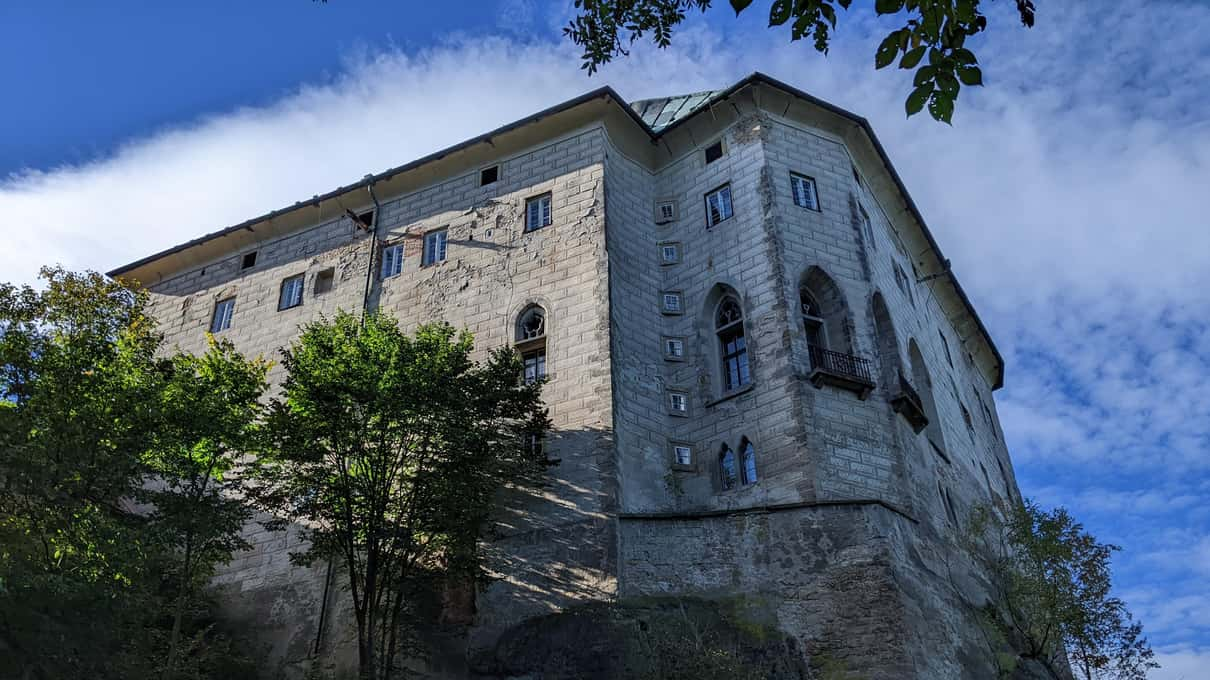
Most visitors leave the car at the large car park about 700 m below the castle and cover the rest on foot, roughly ten minutes. Houska stands on a sandstone rock in the eastern Kokořínsko hills, about 47 km (29 miles) north of Prague as the crow flies, and from the path it looks less like a fortress than a pale manor house that has drawn its shoulders up against the trees.
You cannot wander the interiors alone. Every visit is a guided tour, and tours leave on the full hour, so arriving at 11:10 am means waiting for the noon group. The last tour, and the last entry to the outer courtyard, is one hour before closing. An adult ticket costs 180 CZK and a reduced one 130 CZK, while two adults with two children pay 520 CZK on the family ticket. Opening days change through the season, so check our tickets and opening hours page before you set out.
A castle that seems to guard nothing
Before the chapel, it helps to know why people find Houska so unsettling. The argument the legend leans on goes like this. The castle has no water source and sits far from any trade route. Its defenses, so the story claims, face inward rather than out toward an attacker. A castle built that way, locals say, was never meant to keep anyone out. It was meant to keep something in.
Historians read the same walls more calmly. Houska was founded in the 13th century, traditionally under King Přemysl Otakar II (some scholars credit the lords of Dubá in the 1280s instead), and it first appears in writing in 1316. They see a royal administrative seat, not a lid on a pit. Both versions are told at length in our legend and history guide, though once you stand in the chapel the first one has a way of creeping back.
The chapel over the pit
The center of the visit is the Gothic chapel in the north wing. Its walls carry murals from around 1330 and from the early 15th century, and two figures stand out. One is St Michael fighting the dragon, the archangel who in Christian tradition casts the devil out of heaven. The other is St Christopher, the giant who carries travelers across dangerous water. For a room that legend says was built to seal a gateway to hell, that choice of guardians is hard to ignore.
The story goes that before the castle there was only a rift in the rock, so deep that nobody could see the bottom, and that winged, half-human creatures crawled out of it after dark. A prisoner condemned to death was offered a pardon if he let himself be lowered into the hole on a rope. Within seconds he was screaming to be hauled back up, and the men who pulled him out found a face that had aged by decades. He died a few days later, the tale says, without ever explaining what he saw. The chapel was then built directly over the opening to close it for good.
None of that is documented, and the castle's own site tells it as legend. The recorded facts are quieter. The chapel was restored in 1928, during the Šimonek renovation, and its paintings are dated to the 14th and early 15th centuries. Other ghosts have gathered around the place over the years, among them a faceless figure in a black monk's hood, and the official site passes on the rumor that skeletons of "non-humans" lie in the passages underneath. Whether you feel anything standing on that floor is between you and the rock.
Let someone else drive to the gate of hell
The only Houska tour on GetYourGuide is a private day from Prague at ~$923 for up to three people, with tickets for Houska and Kokořín plus a Czech lunch included.
Renaissance rooms and a darker century
Between 1584 and 1590 the castle was rebuilt in Renaissance style, and that work turned Houska from a Gothic stronghold into something much closer to a residence. The tour moves through rooms shaped by that later life, when owners adapted the house for living in rather than for defense. The castle publishes no room-by-room description, so we will not guess at one.
The modern chapter begins in 1924, when Josef Šimonek, the industrialist who led the Škoda Works, bought the castle and had it restored by 1930. During the Second World War Houska lay in the Sudetenland and was used by the German army until 1945. Czech sources add that SS staff and an archive of the Nazi security office (the RSHA) were moved here in 1943. That record is the seed of the darker rumors about occult experiments, which no evidence supports, since the documented wartime use was military and archival. After 1989 the castle went back to the Šimonek heirs, and in 1999 it opened to the public for the first time in its history.
PEKLEM, the hell in the carriage house
After the tour, walk over to the former carriage house. PEKLEM, which the castle also calls Dante's Inferno, is a separate exhibit that you see on your own, with its own 80 CZK ticket. Inside is a hand-carved mechanical hell made of limewood, 12 m (39 feet) long and 2 m (6.5 feet) high, laid out in 11 scenes. Where the chapel only hints at what might lie under the floor, PEKLEM puts the whole underworld on show in carved wood. Because it is self-guided, you decide how long to stay.
What the castle does not publish
Some basics are missing from the official site, and we would rather say so than guess.
- Tour length. Not stated. Allow a couple of hours on site with PEKLEM and the walk from the car park, and avoid a tight onward connection.
- Language. The castle's site does not say whether tours run in English. Ask at the gate whether an English tour or a written English text is available that day.
- Photography. Photo rules are not published. Ask before you raise a camera in the chapel, and leave the flash off unless staff say otherwise.
- Paying. Online tickets and card payment are not confirmed either, so carry some Czech crowns in cash as a backup.
Outside the walls
The visit does not have to end at the gate. The castle has opened a new trail around its rock, which shows you from outside the walls that legend says were built facing the wrong way, and there is a children's game for young visitors ("for little princes and princesses", in the castle's words). Dogs may come along for 40 CZK.
Kokořín Castle is only 12 km (7.5 miles) away by road, about 20 minutes. Where Houska turns inward, Kokořín lifts a tall tower over a wooded valley, and our Kokořín guide covers its hours and the walk up. To fit both into one day from Prague, see how to plan the day trip. The roads, the car park and the seasonal bus are in our getting-there guide.